Does going first increase your Commander win percentage? For one casual game, treat the answer as no: deck strength, the opening seven, threat assessment, and three opponents’ decisions matter far more than the die roll. Across thousands of recorded games, though, seat one does win more often on average. In cEDH, the first-seat advantage is pronounced enough to be a strategic concern.
Why casual Commander often feels seat-neutral
First seat gets the first land drop and reaches every turn milestone before the rest of the table. Unlike a two-player game, however, multiplayer Magic lets every player draw on their first turn. Later seats also receive more information before acting, and the player who develops first can attract the first removal spell or become the table’s early target.
Casual games add even more noise: unequal deck power, loose mulligans, politics, experimental cards, and wide differences in player experience. Those factors can swamp a small positional edge in any single pod. That is why “I always lose from seat four” is usually a hypothesis, not a conclusion.
What broad Commander data says
Aggregate tracking complicates a flat “no.” A 2026 analysis of hundreds of thousands of logged Commander games reported a descending win rate from the first seat to the last across three-, four-, and five-player pods. The data is observational—seating, player strength, deck selection, and reporting are not fully controlled—so it establishes a pattern, not a universal law for every kitchen table.
The practical conclusion is modest: going first may improve the average casual result, but it should not change your social contract or become an excuse for a loss. If you want to know whether it matters in your group, log seat and result, then compare positions after enough games.
Why going first matters more in cEDH
cEDH compresses the game. Cheap acceleration, compact win conditions, free interaction, and aggressive mulligans make the first meaningful window arrive sooner. Seat one can deploy a value engine or present a win before later seats receive an equivalent untap. Players farther around the table may also spend interaction stopping earlier attempts, leaving fewer resources for the next.
Current cEDHStats seat data shows tournament performance declining from seat one through seat four across a very large pool of pods. Individual tournaments can buck that order, but the broader competitive pattern is clear: earlier seats earn more wins and points over time.
How to play each position
- Seat one: use the tempo, but do not expose more than the plan requires. In casual games, being first to look threatening can erase the advantage.
- Seat two: pressure the first player when necessary while preserving resources for the players behind you.
- Seat three: mulligan with awareness that two players may develop or attempt a win before your first untap.
- Seat four: use the extra information. Your opening hand should interact early or advance efficiently without assuming the table will solve every threat.
Test the claim in your own pod
Record pod size, starting player, each player’s seat, deck, and winner. Avoid combining casual and cEDH games. After at least several dozen games, calculate wins from each seat and compare them with that seat’s share of games. If the same person or strongest deck often occupies one position, separate those results before blaming turn order.
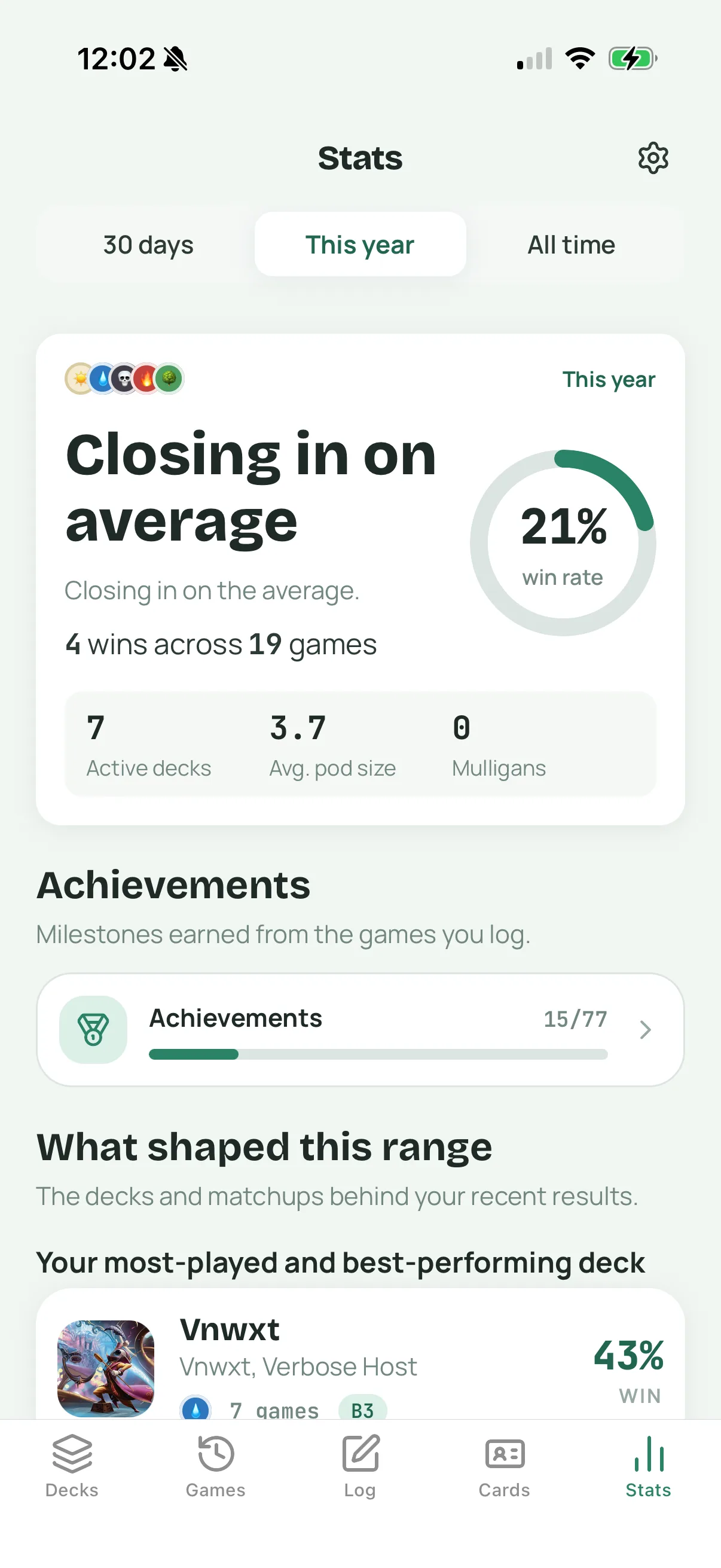
WUBRG includes seat and result in its game log, which makes this question easy to revisit without relying on memory. A pattern from your regular group is more actionable than a global average because it reflects the decks, players, and pace you actually face.
Turn-order FAQ
Does the first player draw on turn one in Commander?
Yes. In a multiplayer Commander game, the first player draws during their first draw step. The familiar skipped draw applies to two-player games.
What is the best seat in cEDH?
Seat one is generally the strongest according to broad tournament data. The exact edge varies by event, metagame, deck, and how draws are scored.
Should a casual pod compensate the last player?
Usually no. Randomize the starting player and rotate naturally across repeated games. If your own log shows a severe persistent imbalance, discuss rotating seats or first player as a group.