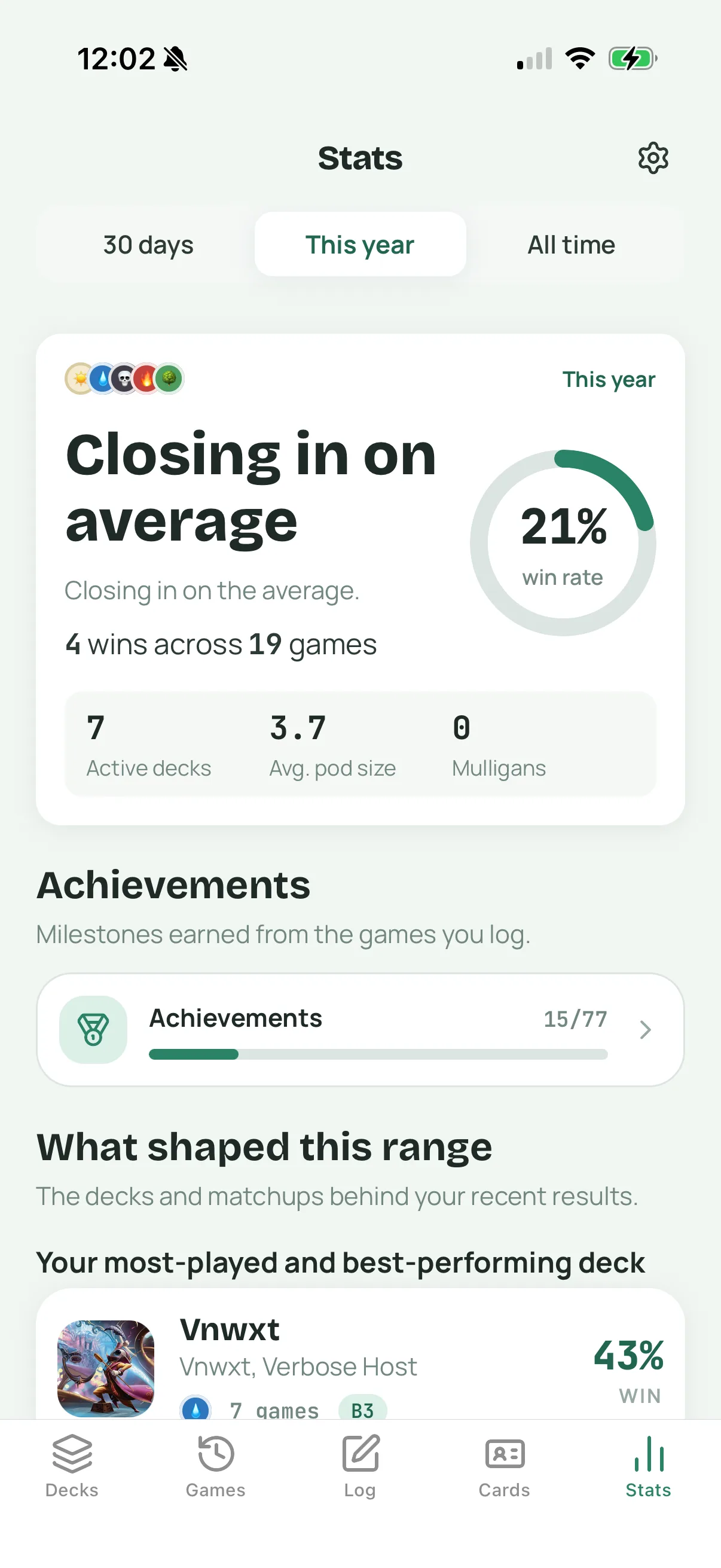
To track your Commander win rate, record every completed game and divide your wins by your total games. If you win 7 of 28 games, your win rate is 25%. That is the fair-share baseline in a four-player pod, assuming every player is equally likely to win.
Do not compare that 25% directly with a two-player format, where one player must win half the time in a balanced matchup. Commander has three opponents, shifting alliances, uneven deck strength, and occasional draws. Context is not a footnote—it is what makes the percentage interpretable.
What should count as a game?
Decide once, then stay consistent. Count a game when the pod begins normal play and reaches an agreed result. Do not quietly remove mana-screwed losses, experimental keeps, or games where you became the archenemy. Those are part of how the deck performs in real play.
Exclude restarts caused by a rules mistake, an immediate player emergency, or a game the whole table agrees never meaningfully began. Record intentional draws separately. If your league awards shared wins, keep that league metric separate from ordinary win rate so the two remain understandable.
Log the minimum useful context
A win/loss tally answers “how often?” but not “why?” For each game, capture the date, your deck, the other commanders or decks, pod size, starting seat, winner, and total turns. Add one short note only when something exceptional happened, such as a missed trigger, a mulligan to four, or testing a new deck version.
That is enough to split your record later: deck win rate, win rate by pod size, results against a regular opponent, or performance before and after an upgrade. Our free Commander game log template uses exactly this structure. If spreadsheets become maintenance work, WUBRG records the same core details in a purpose-built Commander game log.
How many games make a useful sample?
Five games can describe what happened; they cannot reliably describe what will happen. One additional win moves a 2–3 record from 40% to 50%. After 20 games, a single result moves the displayed rate by about five percentage points; after 50, by about two. Treat 20 games as an early signal and 30–50 comparable games as a much better basis for tuning decisions.
“Comparable” matters. Ten games in a precon pod and ten against highly tuned combo decks do not form one clean experiment. Keep them in the complete history, but filter by deck version, pod, or power environment before drawing conclusions.
Compare win rate with the correct baseline
| Pod size | Equal-share baseline | Calculation |
|---|---|---|
| 3 players | 33.3% | 1 ÷ 3 |
| 4 players | 25% | 1 ÷ 4 |
| 5 players | 20% | 1 ÷ 5 |
If pod sizes vary, a single overall rate can mislead. A player with many three-player games has more opportunities to win than one who mostly plays five-player games. View each pod size separately or compare each result with that pod’s equal-share baseline.
Use win rate to ask better questions
A high number is not automatically a healthy result. A 45% deck in a casual four-player group may be too strong for that table. A 17% deck can still be succeeding if it creates close games, executes its theme, and is fun to play. Win rate is most useful as a prompt:
- Did the rate change after a specific deck revision?
- Does the deck struggle in larger pods or against one archetype?
- Are losses caused by mana, card access, threat assessment, or closing?
- Is the deck winning far more than its agreed power level should?
WUBRG keeps a per-deck record and version history, so you can compare a deck before and after swaps without rebuilding the evidence from memory. The goal is not to turn every game night into a tournament. It is to make the games you already play easier to understand.
Commander win-rate FAQ
What is a good win rate in Commander?
Around 25% is the equal-share baseline in a balanced four-player pod. “Good” depends on pod size, deck strength, opponents, and whether the games are casual or competitive.
Should draws count in Commander win rate?
Keep draws in total games when calculating outright win rate, and also report them separately. For example: 8 wins, 2 draws, 30 games; 26.7% win rate and 6.7% draw rate.
Should I track player win rate or deck win rate?
Track both. Player win rate reflects piloting across everything you play; deck win rate is more useful when deciding whether a particular list is performing as intended.